Nintendo has reported its results and the easy headline is the bad one: hardware sales are down 30%, counting both Switch 2 and the original Switch. Stop there and the conclusion is that the successor isn’t working.
Look one line further down and the conclusion flips: profits are up. And that contradiction is the real story of the industry this year.
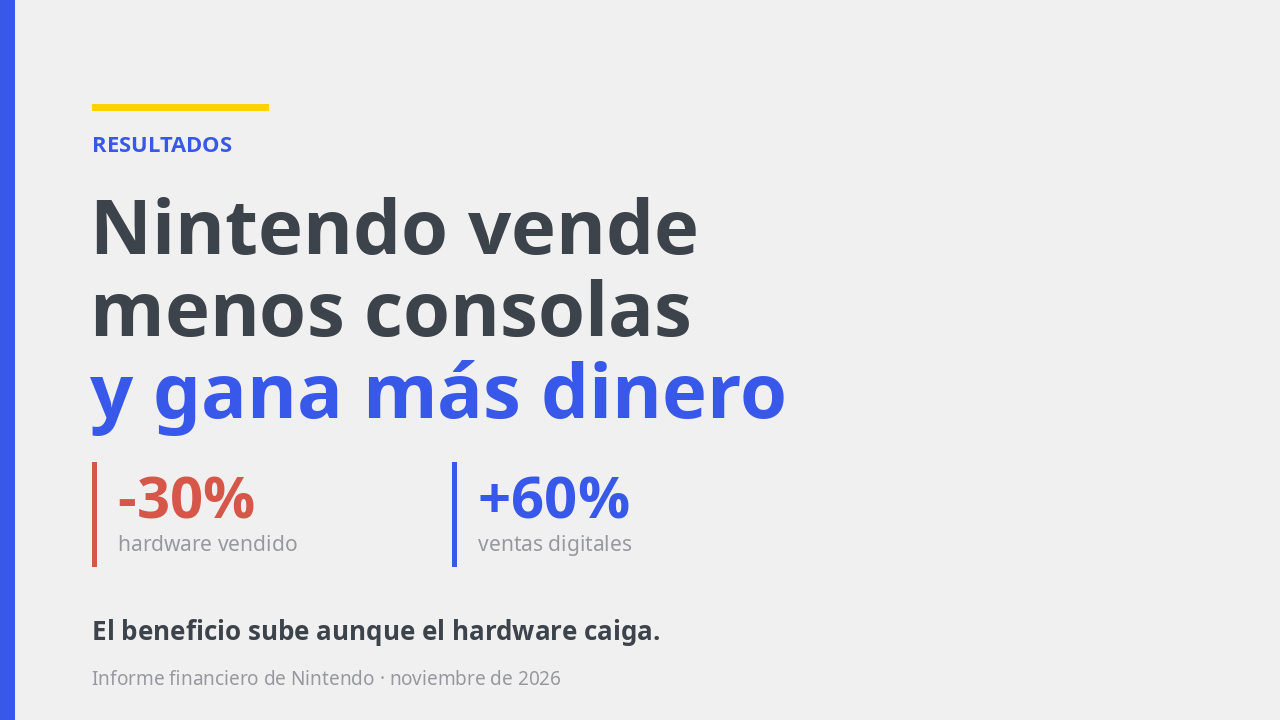
Fewer consoles, more money

Nintendo’s report contains both a 30% drop in hardware sales and a rise in profit. Both are true and they don’t contradict each other: the console is no longer the engine of the business.
The figure that explains it is another one: digital sales grew 60% on the previous period. A game bought on the eShop has no cartridge, no box, doesn’t pass through a shop and doesn’t share margin with anyone. Trading a physical sale for a digital one can lower revenue and raise profit at the same time.
Which is why the usual metric deserves suspicion. “Consoles sold” was the sector’s thermometer for twenty years and today it measures less and less.
Star Fox and the million that used to be a failure
The Switch 2 best-seller list includes Star Fox, with just over one million copies. A generation ago, a million was the threshold of respectability. Today, with development budgets having multiplied, it’s a figure to read carefully: it doesn’t say whether the game made money, it says how many people bought it.
And there’s the problem nobody wants in the headline: a name-brand franchise can sell a million and still be a financial unknown, because the cost isn’t in the copy, it’s in the three thousand people and four years behind it.
The other side: PS5 and Wolverine
Sony used its report to update figures: nearly 98 million PS5s sold. That’s an enormous number and, at the same time, proof that the installed base is already built: the future business isn’t selling the console, it’s selling inside it.
The interesting figure is the other one: Marvel’s Wolverine sold 2.4 million copies in fifty days. That’s not nothing. The question it leaves open is far more uncomfortable than the number: is it enough? For an exclusive of that size and cost, the answer isn’t in copies sold but in what each of those copies cost to make.
How Nintendo sets prices, according to Nintendo
The most useful part of the report isn’t the charts: it’s that its executives explained their pricing policy. Shuntaro Furukawa, Ko Shiota, Shinya Takahashi and Yusuke Beppu effectively said the company tries to absorb moderate cost increases, that price rises aren’t ruled out, and that for now they are not considering a further increase in the Switch 2 price.
Translated: there is no commitment to hold the price. There is an intention to hold while costs remain “moderate”. That’s exactly what the whole sector does, and it’s worth reading it that way when the next rise comes.
And what’s coming, which is what really decides
The same executives called Pokémon Wind and Waves a “crucial” release now that the console enters its third year. That isn’t filler: it’s an admission that year three is when a platform proves whether it has a catalogue of its own or lives off what already existed.
By then, the question won’t be how many Switch 2s have sold. It will be how many of those players buy every month, which is the only figure that sustains a seven-year generation.
What you should watch, as a player
- The cheap hardware isn’t coming. If you were waiting for a Switch 2 price cut to offset falling sales, the report itself says it isn’t on the table.
- Digital rises, physical stays. 60% more digital sales means fewer physical editions on shelves over time. If you collect, that’s your clock.
- Exclusives will be scrutinised. When a game sells 2.4 million and people still ask whether it’s enough, the next risk cut is paid by you in the form of a franchise that doesn’t get renewed.
Figures from Nintendo’s and Sony’s financial reports for November 2026, and from statements by Shuntaro Furukawa, Ko Shiota, Shinya Takahashi and Yusuke Beppu reported by the specialist press (5 and 7 November 2026). Sales and profit figures are period figures and may be revised in the companies’ official reports.



Be the first to leave a comment